Name the rock in your hand with six field tests.
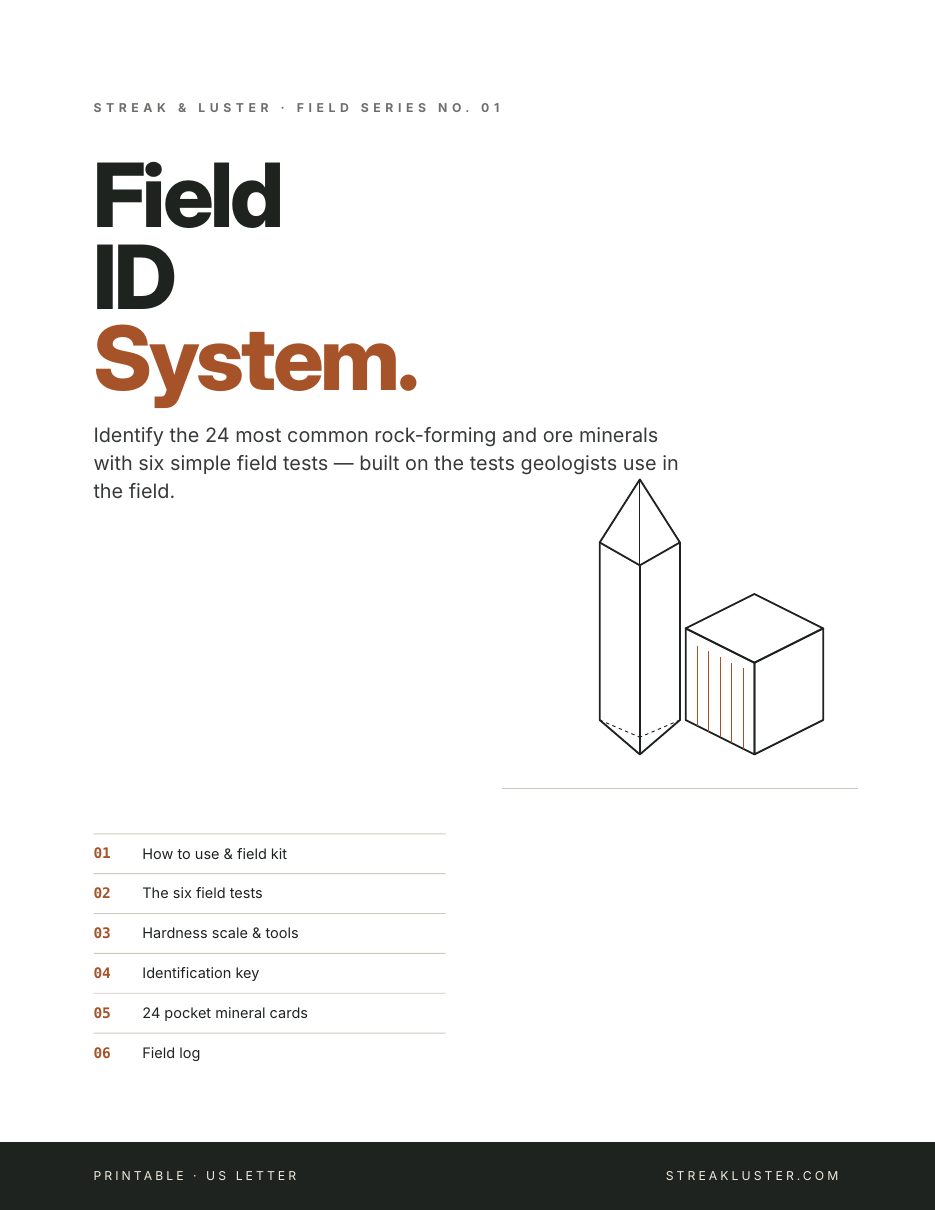
A printable identification system for the 24 minerals you will actually find: pocket cards, a two-page key and a field log. It uses the tests geologists use, so it works when photos and apps don't.
Pyrite and gold look alike in the creek. On the plate, one streaks greenish-black and the other golden-yellow.
What you print.
Thirteen pages, typeset for clear reading in the field. These are the real pages from the PDF.
Six tests, run in order.
Color changes with weathering and light. Physical properties don't. Each test takes under a minute with a pocket kit and rules out most of the wrong answers.
Luster
Metallic or not? This first split halves the list.
Hardness
Fingernail, copper coin, steel, glass. Place it on the Mohs scale.
Streak
The powder color, which stays the same when the rock's color doesn't.
Cleavage
Count the flat breaks and judge their angles: sheets, cubes, rhombs.
Heft
Specific gravity by hand, against a piece of quartz.
Special tests
Magnet, acid fizz, UV glow, double image, malleability.
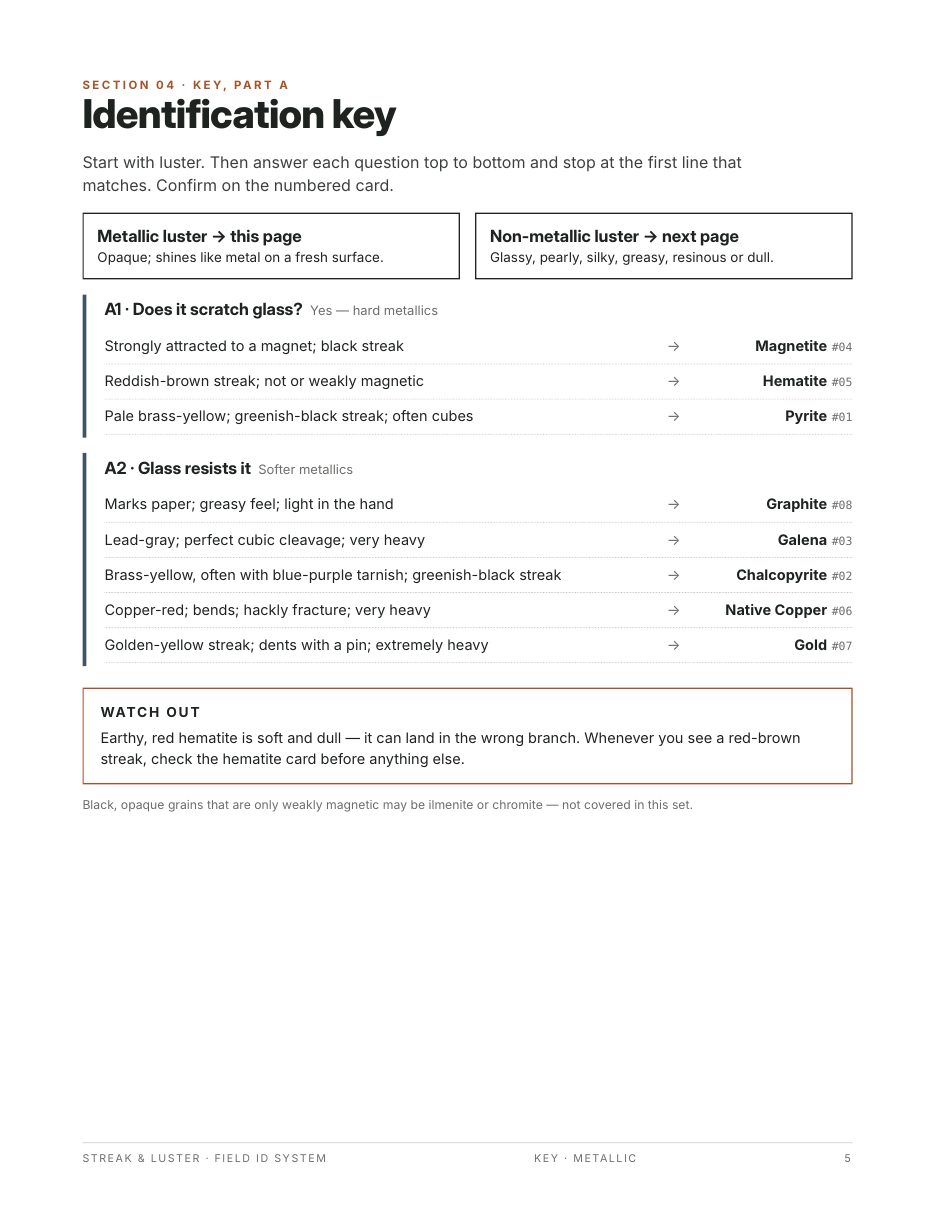
A mini version of the key.
Pick what you see on your specimen. The full kit then confirms the answer with streak, cleavage and look-alikes on each card.
Candidates
The full key separates these with cleavage and special tests.
The 24 minerals.
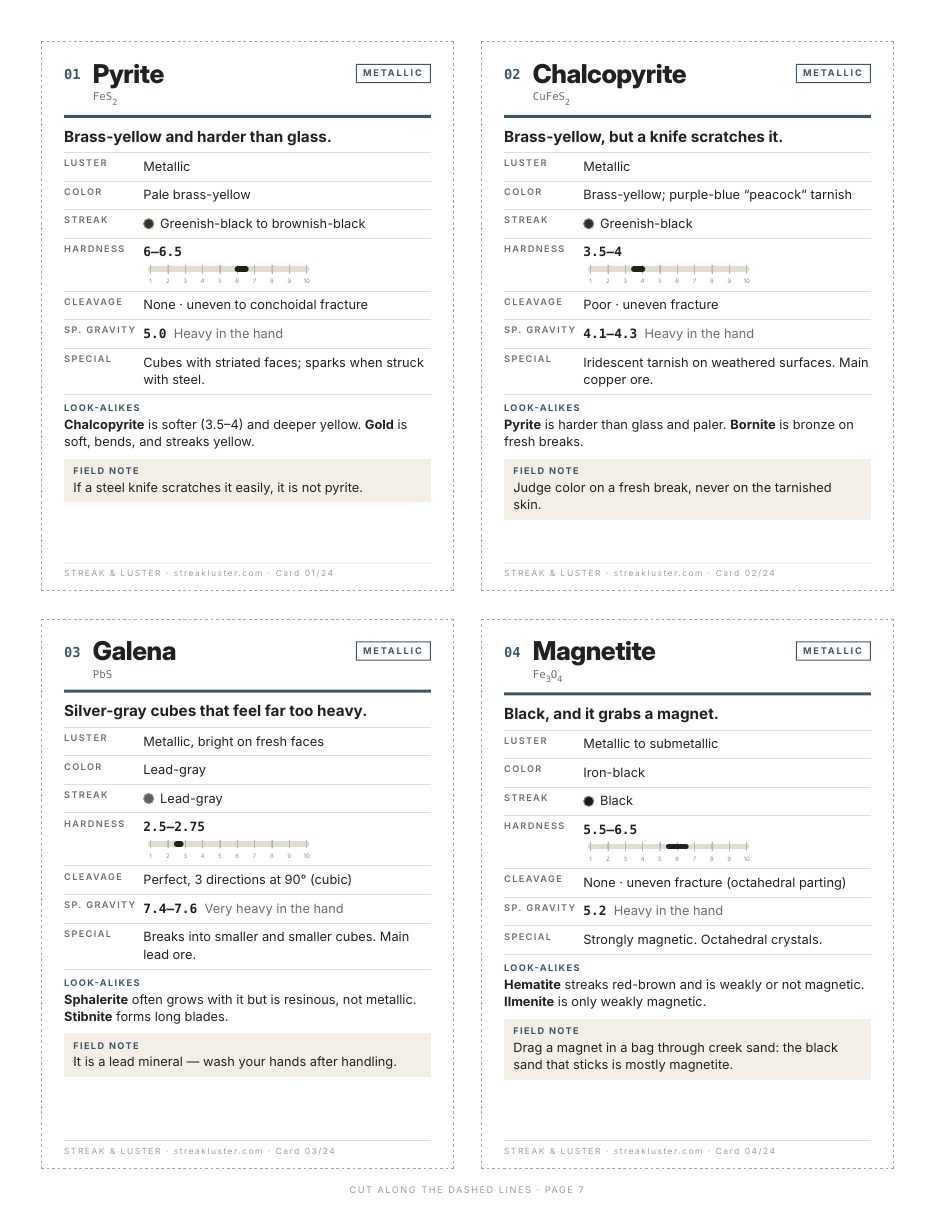
The rock-forming and ore minerals behind most finds in US creeks, road cuts and mine dumps. Each gets its own pocket card.
Print it, cut it, take it to the field.
Designed for cardstock. Four cards per page, sized to fit a trading-card sleeve.
Hematite
- Luster
- Metallic to dull/earthy
- Streak
- Reddish-brown
- Hardness
- 5–6.5
- Cleavage
- None · uneven to splintery
- Sp. gravity
- 5.3 · heavy in the hand
- Look-alikes
- Magnetite streaks black and pulls a magnet.
- p. 2How to use & field kitThe workflow, a kit checklist, BLM collecting limits and safety.
- p. 3The six field testsHow to run each one, with the mistakes beginners make.
- p. 4Hardness scale & toolsMohs scale matched to the tools in your pocket.
- p. 5–6Identification keyFrom luster to a mineral name in three questions.
- p. 7–1224 pocket cardsQuartz to gold, pyrite to plagioclase, each with its look-alikes.
- p. 13Field logRecord where and how you identified each find.
Before you buy.
Is this a physical product?
No. It is a PDF you download right after purchase and print at home or at a print shop. Nothing ships.
Who is it for?
Adult rockhounds and serious beginners who want to identify finds themselves. It is detailed enough for clubs and homeschool high school too.
What paper should I use?
Print at actual size. Use 65–110 lb cardstock for the cards and plain paper for the guide pages. Laminate or sleeve the cards for wet trips.
Which minerals does it cover?
Pyrite, chalcopyrite, galena, magnetite, hematite, native copper, gold, graphite, quartz, orthoclase, plagioclase, calcite, dolomite, gypsum, halite, fluorite, muscovite, biotite, garnet, olivine, hornblende, augite, talc and malachite.
Is it A4?
This edition is US Letter. Most printers scale it to A4 cleanly with "fit to page".
Field ID System
24 cards, the key, the tests and a field log. One PDF, yours to print as often as you like.